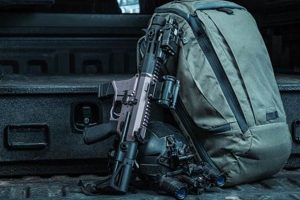
The selection of appropriate load-bearing equipment is paramount for military personnel. A suitable rucksack provides the capacity to transport essential gear, ranging from communication devices and medical supplies to survival necessities and protective equipment. Functionality centers on durability, carrying capacity, organizational features, and comfort during extended use in diverse operational environments.
Properly chosen and fitted carrying equipment significantly impacts mission effectiveness and soldier well-being. Such equipment facilitates the efficient transport of critical supplies, reduces physical strain and potential injury, and enhances maneuverability across varied terrains. Historical precedents highlight the evolution of these packs, driven by technological advancements and battlefield experience, constantly adapting to meet the changing demands of modern warfare.
Subsequent discussion will delve into key factors influencing optimal rucksack selection, including load capacity, construction materials, ergonomic design, and specialized features. Furthermore, specific examples and comparative analyses will illustrate the differences between various models designed for distinct operational requirements.
Selection Guidance for Military Rucksacks
Optimal selection of a military rucksack requires careful consideration of mission parameters, load requirements, and environmental factors. The following points provide essential guidance for personnel involved in the procurement or individual selection process.
Tip 1: Load Capacity Assessment: Prioritize a model with sufficient volume to accommodate all mission-essential equipment and supplies. Conduct a thorough inventory of required items and select a rucksack that provides adequate space without excessive bulk.
Tip 2: Durability and Material Composition: Evaluate the rucksack’s construction materials for resistance to abrasion, tearing, and water infiltration. High-denier nylon or similar rugged fabrics are preferred for their enhanced durability in demanding environments.
Tip 3: Ergonomic Design and Comfort: Consider the design of the shoulder straps, hip belt, and back panel to ensure proper weight distribution and minimize strain on the back and shoulders. Adjustable features allow for customization and optimal fit.
Tip 4: Organizational Features: Choose a rucksack with a variety of internal and external pockets, compartments, and attachment points to facilitate efficient organization and easy access to critical items.
Tip 5: Environmental Considerations: Account for the operational environment when selecting a rucksack. Features such as water resistance, camouflage patterns, and compatibility with hydration systems are critical for maintaining functionality and survivability.
Tip 6: Frame Type and Support System: Internal or external frames can provide added support for heavier loads. Evaluate the frame’s construction and adjustability to ensure optimal weight transfer to the hips.
Tip 7: MOLLE Compatibility: Modular Lightweight Load-carrying Equipment (MOLLE) webbing allows for the attachment of additional pouches and accessories, expanding the rucksack’s carrying capacity and versatility.
Adherence to these guidelines will facilitate the selection of a military rucksack that maximizes mission effectiveness, minimizes physical strain, and enhances overall operational readiness.
Further evaluation of specific rucksack models, comparative performance data, and user feedback is recommended to refine the selection process.
1. Durability

Durability, in the context of military rucksacks, constitutes a foundational attribute directly impacting operational effectiveness and soldier survivability. The ability of a rucksack to withstand harsh environmental conditions, rigorous use, and potential combat damage determines its long-term utility. Failure due to material degradation or structural compromise can lead to equipment loss, mission disruption, and increased vulnerability for the individual service member. Therefore, a robust construction is paramount in the selection of the “best army backpack”. A pack that quickly degrades would make it not the best.
The selection of high-denier fabrics, reinforced stitching, and robust hardware directly contributes to a rucksack’s durability. For instance, a rucksack constructed from 1000D nylon exhibits superior resistance to abrasion and tearing compared to those utilizing lower-denier materials. Similarly, reinforced stitching at stress points, such as shoulder strap attachments and zipper closures, prevents premature failure under heavy loads. The implementation of water-resistant coatings or waterproof liners further enhances durability by protecting carried equipment from environmental exposure. Real-world examples, such as prolonged deployments in arid or jungle environments, consistently demonstrate the critical importance of these features in maintaining the functional integrity of a military rucksack.
In summary, the durability of military load-bearing equipment is not merely a desirable characteristic but a fundamental requirement. Prioritizing robust materials, reinforced construction, and weather resistance is essential for ensuring the long-term reliability and operational effectiveness of a rucksack. Challenges persist in balancing durability with weight and cost considerations, but the potential consequences of equipment failure underscore the imperative of selecting a rucksack that can withstand the rigors of military service.
2. Capacity
The capacity of a military rucksack directly determines its suitability for a given mission. Insufficient carrying volume necessitates compromises in required equipment, potentially jeopardizing mission success. Conversely, excessive capacity introduces unnecessary weight and bulk, hindering maneuverability and increasing soldier fatigue. Therefore, a carefully considered capacity is a crucial element of any “best army backpack.” For example, a reconnaissance patrol requiring extended self-sufficiency demands a larger capacity pack to accommodate rations, water, and specialized surveillance equipment, whereas a short-duration assault mission may prioritize a smaller, more streamlined pack to enhance speed and agility.
The assessment of required capacity begins with a comprehensive inventory of all essential items. This includes communication devices, medical supplies, ammunition, navigation tools, protective gear, and personal sustenance. The volume and weight of each item must be accurately accounted for to determine the optimal rucksack size. Furthermore, consideration must be given to the potential for mission-specific equipment additions. A failure to adequately assess and accommodate these factors can result in overloaded packs, improper weight distribution, and ultimately, diminished operational effectiveness. Historical examples demonstrate the consequences of inadequate capacity, ranging from supply shortages during extended operations to compromised situational awareness due to overburdened soldiers.
In summary, capacity represents a critical performance parameter in the selection of a military rucksack. Matching rucksack volume to mission requirements and carefully managing weight distribution is paramount. Challenges remain in achieving a balance between carrying capacity, weight, and maneuverability, but the ability to efficiently transport essential equipment directly contributes to mission accomplishment and the well-being of the individual soldier. Ultimately, the designation of “best army backpack” is inextricably linked to its capacity to effectively meet the specific demands of its intended operational environment.
3. Ergonomics

Ergonomics represents a critical design consideration in the selection of load-bearing equipment for military personnel. The interaction between the rucksack and the human body significantly impacts soldier comfort, endurance, and overall performance. An improperly designed pack can lead to musculoskeletal strain, fatigue, and decreased cognitive function. Therefore, ergonomic features are essential in any assessment of the “best army backpack.”
- Load Distribution
Effective load distribution minimizes stress on specific muscle groups and joints. Internal or external frames, adjustable torso lengths, and strategically placed padding help distribute weight evenly across the back, shoulders, and hips. This prevents localized pressure points and reduces the risk of injury. A rucksack with poor load distribution can lead to lower back pain, shoulder impingement, and compromised mobility.
- Suspension System Design
The suspension system, comprising shoulder straps, hip belt, and back panel, plays a crucial role in transferring weight from the shoulders to the hips. Contoured shoulder straps prevent chafing and restrict arm movement. A well-padded hip belt supports a significant portion of the load, reducing strain on the back. Breathable back panels promote ventilation and minimize perspiration buildup, enhancing comfort in hot climates. A poorly designed suspension system can lead to discomfort, decreased endurance, and impaired operational effectiveness.
- Adjustability
Adjustability is essential to accommodate a wide range of body sizes and shapes. Adjustable torso lengths, shoulder strap heights, and hip belt circumferences allow for a customized fit, optimizing weight distribution and comfort. A rucksack that cannot be properly adjusted will likely cause discomfort, reduce mobility, and increase the risk of injury. Military personnel often operate in diverse environments and under varying load conditions, making adjustability a critical requirement.
- Range of Motion and Mobility
An ergonomically designed rucksack should not unduly restrict range of motion or impair mobility. The design should allow for freedom of movement in the arms, legs, and torso, enabling soldiers to perform essential tasks without hindrance. A bulky or poorly designed pack can impede movement, increase the risk of falls, and compromise combat effectiveness. The “best army backpack” facilitates, rather than hinders, the wearer’s ability to perform their duties.
The ergonomic design of a military rucksack directly impacts the health, well-being, and operational performance of soldiers. Attention to load distribution, suspension system design, adjustability, and range of motion is essential when selecting load-bearing equipment. A rucksack that prioritizes ergonomic principles will minimize physical strain, enhance comfort, and ultimately contribute to mission success. Thus, ergonomics holds a central position in defining what constitutes the “best army backpack.”
4. Organization
Effective internal compartmentalization and external attachment points directly enhance a soldiers operational readiness. A well-organized rucksack permits rapid access to essential items, mitigating delays during critical situations. The strategic placement of pouches and dividers facilitates the segregation of equipment by category, preventing entanglement and minimizing the time required to locate specific tools or supplies. The absence of a robust organizational system can lead to inefficiencies, particularly under duress, thereby compromising mission effectiveness. Military rucksacks incorporating dedicated compartments for communication devices, medical kits, and ammunition exemplify effective organization strategies.
Military units frequently implement standardized packing lists and organizational protocols to ensure uniformity and promote rapid deployment. Pre-configured pouches, color-coded labels, and designated storage locations contribute to streamlined operations and facilitate equipment accountability. Moreover, the inclusion of external attachment points, such as MOLLE webbing, allows for the customization of carrying capacity and the integration of mission-specific equipment. The capacity to adapt to diverse operational requirements through modular organization is a defining characteristic of a high-quality military rucksack. An example would be adding a larger medical pouch for combat medic, or an extra ammo pouch for a rifleman.
In summary, the organizational features of a military rucksack directly influence its usability and impact a soldier’s overall effectiveness. Prioritizing compartmentalization, accessibility, and modularity facilitates efficient equipment management and contributes to mission success. The challenges associated with balancing organizational complexity and ease of use necessitate careful consideration of design and functionality. A rucksack that excels in organization ultimately enhances situational awareness, promotes rapid response capabilities, and embodies the principles of preparedness in demanding operational environments, making it the “best army backpack”.
5. Adaptability

Adaptability, within the context of military rucksacks, signifies the capacity to readily adjust to diverse mission requirements and environmental conditions. A rucksack lacking adaptability limits its utility, necessitating the use of multiple specialized packs and increasing logistical burdens. The “best army backpack,” conversely, offers a modular design that can be configured to accommodate varying load weights, equipment profiles, and operational scenarios. This adaptability is paramount, enabling a single rucksack to serve across a spectrum of deployments, from reconnaissance missions to sustained field operations. The ability to interchange pouches, adjust carrying capacity, and integrate mission-specific accessories directly influences the rucksack’s overall value and enhances operational efficiency. For instance, a rucksack capable of seamlessly incorporating a sniper’s drag bag or a medic’s trauma kit exemplifies practical adaptability.
Real-world examples underscore the significance of adaptable load-bearing equipment. During rapid deployments to disparate theaters of operation, logistical constraints often preclude the timely procurement of specialized rucksacks tailored to specific environmental conditions or mission objectives. In such scenarios, a versatile rucksack with adjustable features, such as removable rain covers, modular pouch systems, and variable carrying capacity, proves invaluable. The modular lightweight load-carrying equipment (MOLLE) system exemplifies this concept, enabling soldiers to customize their load carriage based on individual roles and mission-specific requirements. The practical significance of this adaptability translates into reduced logistical overhead, enhanced operational flexibility, and improved soldier readiness. A truly adaptable “best army backpack” minimizes the need for redundant equipment and maximizes its utility across a wide range of operational contexts.
In summary, adaptability represents a crucial determinant in the selection of a military rucksack. A rucksack’s capacity to be readily reconfigured, customized, and integrated with diverse equipment sets enhances its operational value and reduces logistical complexities. While challenges persist in balancing adaptability with durability, weight, and cost considerations, the benefits of a versatile load-carrying system far outweigh the drawbacks. A well-designed and adaptable “best army backpack” ultimately contributes to improved soldier effectiveness, enhanced operational flexibility, and reduced logistical demands, facilitating mission success across a broad spectrum of military operations.
Frequently Asked Questions About Military Rucksacks
This section addresses common inquiries regarding the selection, maintenance, and utilization of military rucksacks. Understanding these aspects is crucial for maximizing the effectiveness and lifespan of this essential piece of equipment.
Question 1: What is the typical lifespan of a military rucksack under field conditions?
The lifespan of a military rucksack varies depending on factors such as material composition, frequency of use, environmental conditions, and maintenance practices. Rucksacks constructed from high-denier nylon and subjected to routine care can typically withstand several years of rigorous field use. However, exposure to extreme weather, abrasive terrain, or combat damage can significantly reduce lifespan.
Question 2: How should a military rucksack be properly cleaned and maintained?
Proper cleaning and maintenance are essential for preserving the integrity of a military rucksack. Regular cleaning with mild soap and water removes dirt, debris, and contaminants that can degrade fabric and hardware. After cleaning, the rucksack should be thoroughly dried in a well-ventilated area. Additionally, lubricating zippers and buckles prevents corrosion and ensures smooth operation. Repairing minor tears or damage promptly prevents further deterioration.
Question 3: What is the recommended maximum load capacity for a military rucksack?
The recommended maximum load capacity for a military rucksack depends on the individual’s physical condition, the duration of the mission, and the terrain. Exceeding recommended weight limits can lead to musculoskeletal strain, fatigue, and increased risk of injury. Military doctrine typically dictates maximum allowable loads, which should be strictly adhered to. Load distribution is as important as total weight; packing heavier items closer to the back promotes better balance and reduces strain.
Question 4: How does MOLLE webbing enhance the functionality of a military rucksack?
MOLLE (Modular Lightweight Load-carrying Equipment) webbing provides a standardized system for attaching additional pouches and accessories to a military rucksack. This modularity allows soldiers to customize their load carriage based on specific mission requirements, enhancing flexibility and adaptability. MOLLE webbing enables the integration of communication devices, medical kits, ammunition pouches, and other essential equipment, providing a readily accessible and organized configuration.
Question 5: What are the key differences between internal and external frame rucksacks?
Internal frame rucksacks feature a frame concealed within the pack body, offering a streamlined profile and improved stability for dynamic movements. External frame rucksacks feature a frame extending outside the pack body, providing enhanced ventilation and the ability to carry irregularly shaped or bulky items. Internal frame rucksacks are generally preferred for their comfort and maneuverability, while external frame rucksacks are favored for their load-carrying capacity and structural support.
Question 6: How does the camouflage pattern of a military rucksack contribute to its effectiveness?
The camouflage pattern of a military rucksack aids in concealment and reduces visual detectability in various operational environments. Camouflage patterns are designed to blend with the surrounding terrain, disrupting the rucksack’s outline and minimizing its visibility to potential adversaries. The selection of appropriate camouflage patterns is crucial for maximizing concealment effectiveness and enhancing soldier survivability.
In conclusion, a thorough understanding of rucksack maintenance, load management, and functional design elements is crucial for maximizing its utility. Adhering to best practices and considering mission-specific requirements ensures that the rucksack effectively supports the soldier’s operational effectiveness.
The subsequent section will focus on comparative analyses of specific rucksack models, highlighting their strengths and weaknesses in various operational contexts.
Conclusion
The preceding discussion has explored various facets of military load-bearing equipment, focusing on critical attributes influencing operational effectiveness. Durability, capacity, ergonomics, organization, and adaptability have been identified as essential parameters in evaluating rucksack suitability for military applications. The “best army backpack” embodies a confluence of these qualities, providing a reliable and versatile platform for transporting mission-critical equipment in demanding environments.
Ultimately, the selection of load-bearing equipment represents a critical decision impacting soldier performance, survivability, and mission success. Ongoing advancements in materials, design, and modularity promise to further enhance the capabilities of military rucksacks. Continued research, field testing, and user feedback are essential for refining design principles and ensuring that military personnel are equipped with the most effective and reliable load-carrying systems available. Further assessment of specific mission requirements and operational environments remains paramount in the ongoing pursuit of optimizing the “best army backpack.”